Black-Necked Crane Festival
- Kind
- Modern festival
- Venue
- Gangtey Goenpa
- District
- Wangdue Phodrang
- Region
- Western Bhutan
- Tentative
- Tentative
When it happens
The festival is held on the same Gregorian day each year to welcome the cranes to the valley.
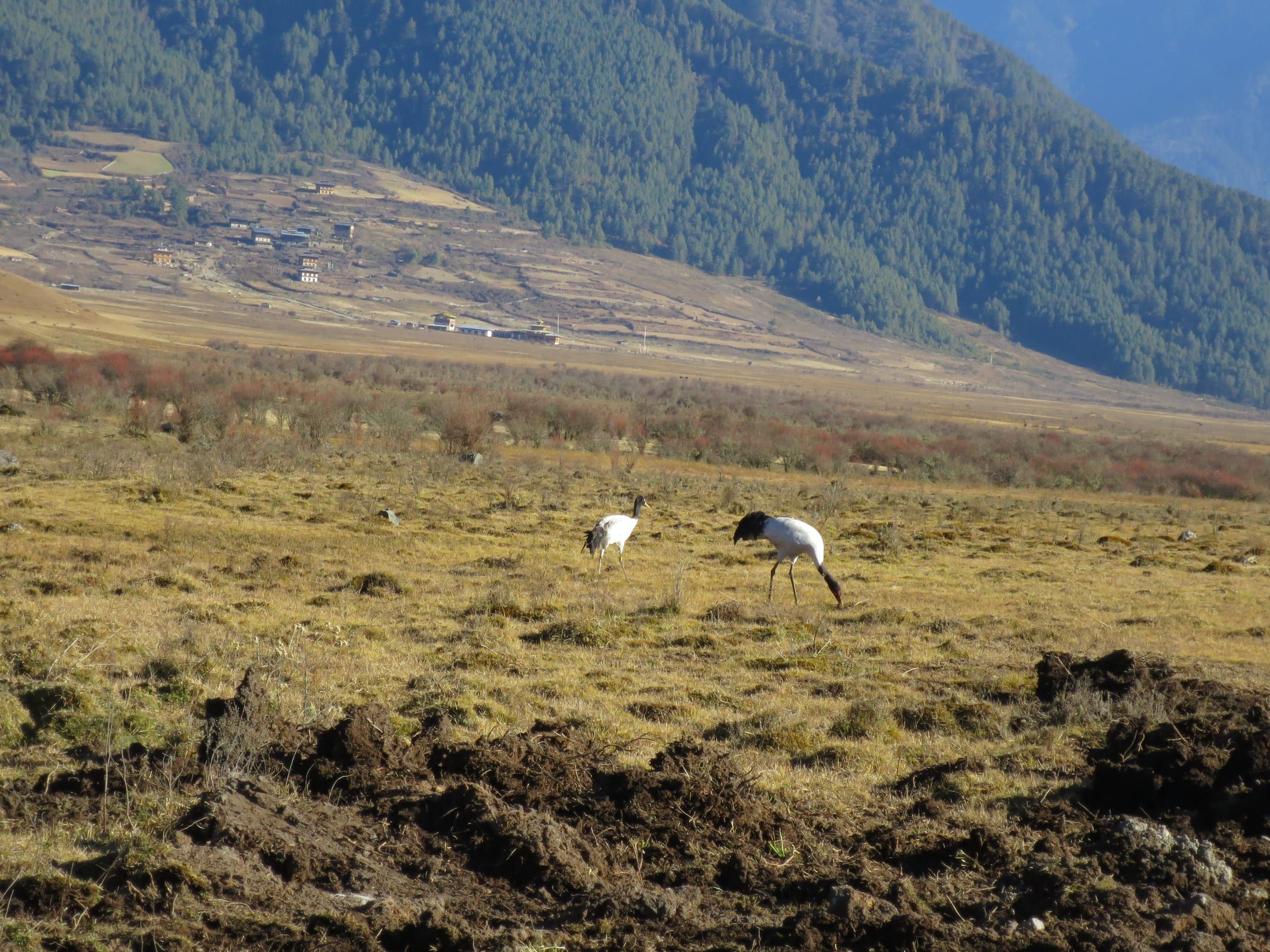
The cranes winter in Bhutan between October and March and start arriving in Phobjikha in late October.
Where it happens
The festival is held in the courtyard of Gangtey Goenpa, in the Phobjikha valley. Phobjikha lies a little more than 68 km from the Wangdue Phodrang district administration.
Phobjikha is the largest winter habitat of black-necked cranes in Bhutan, with approximately 300 birds each year. Bhutan has three main wintering habitats for the species: Phobjikha in the west, Bumthang in the centre and Bumdeling in the east.
History
The Royal Society for Protection of Nature (RSPN), a national non-governmental organisation, started the festival in the late 1990s as part of its Integrated Conservation and Development Programme. RSPN had guidance from the International Crane Foundation in the USA in the early years. RSPN frames the festival as community-based sustainable tourism, in which visitors’ appreciation and payment act as incentives for the valley’s environmental and cultural heritage.
It was first held in the middle of the valley near the old school. Since 2005 it has been held in the courtyard of Gangtey Goenpa. The festival day was moved in 2010. Until 2009 it had been held one day later.
The valley’s environment management committee, made up of elected leaders and development-sector representatives, organises the festival and secures the cooperation of local people and schools. The festival’s stated purposes are to raise awareness of the importance of conserving the endangered black-necked crane, to give local communities an economic incentive, to give local people a way to renew their commitment to conserving the cranes, and to let communities show their cultural heritage and skills.
In 2013 the organisers began collecting an entry fee from tourists to cover the festival’s cost, with the remainder set aside for the following year.
In winter the cranes become part of local people’s daily lives, and they are revered as heavenly birds. Local people sing folk songs as the birds arrive. Locally, their religious significance is often said to be deepened by the report that they mate for life and live for 30 or 40 years. The festival is an occasion for local people to rejoice at the cranes’ arrival.
What happens
The highlight is usually the crane dance, choreographed locally and performed by schoolchildren in crane costumes. In it, the children act out the social behaviour of the cranes in the valley.
The festival’s content is usually described as cultural and educational programmes rather than a set religious sequence. The programme generally includes folk songs, songs about the environment, and masked dances performed by local people, schoolchildren and monks.
Being there
Tourists pay an entry fee. The festival relies entirely on what visitors and supporters of conservation give to keep going.
Phobjikha ranges from 2,800 to 4,000 m above sea level, and the valley floor sits at about 3,000 m. At that height it is likely to be cold in November.
The Black-necked Crane Education Centre in the valley works to build awareness and knowledge of the cranes, the valley’s ecotourism programmes, its plants and wildlife, and the community’s culture.
Accommodation in the valley ranges from three-star hotels to five-star lodges.