Chorten Kora
- Kind
- Sacred observance
- Venue
- Chorten Kora
- District
- Trashiyangtse
- Region
- Eastern Bhutan
- Tentative
- Tentative
The tentative festival calendar lists it as Chhorten Kora.
Attend Chorten Kora with Little Bhutan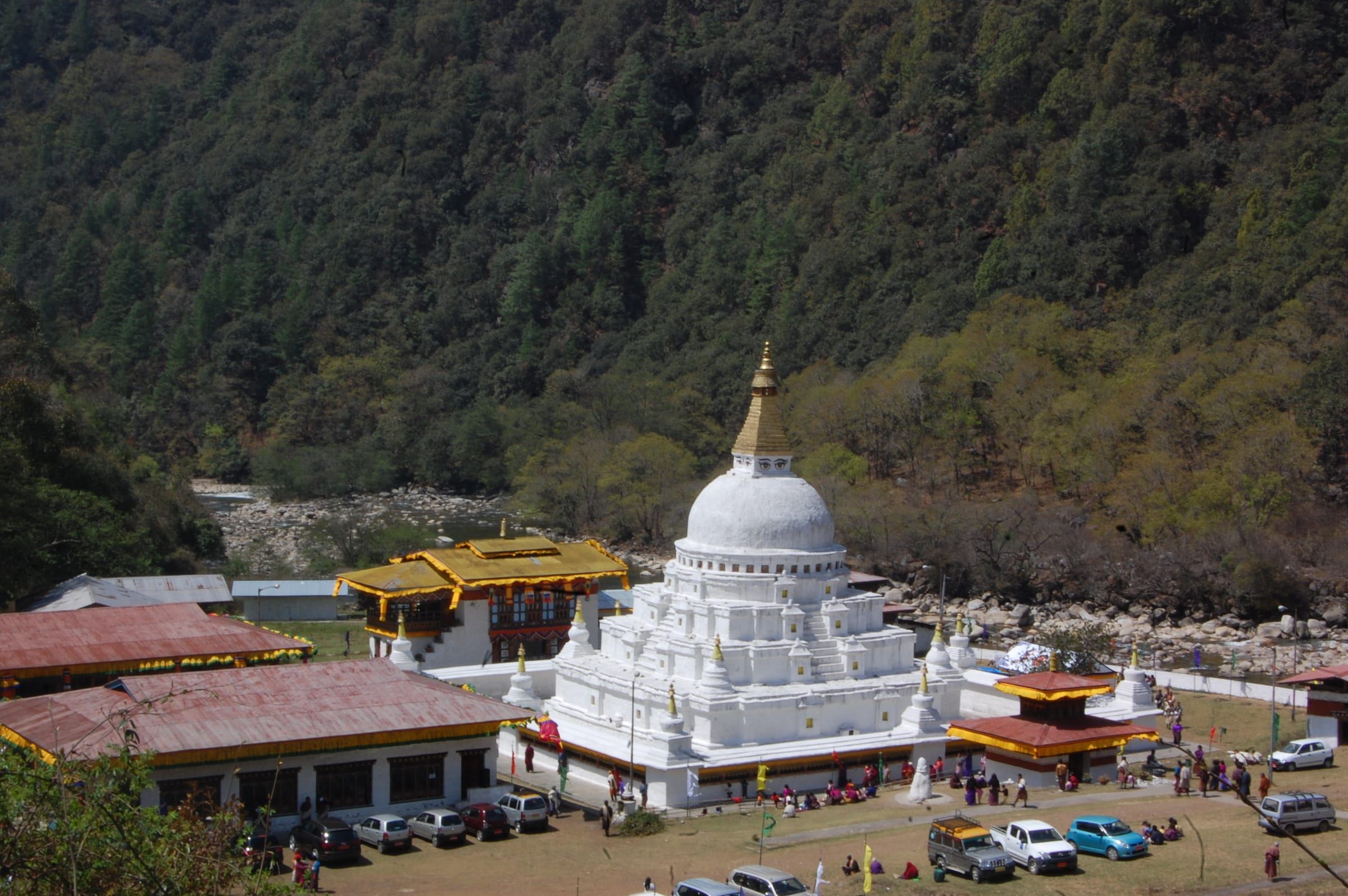
When it happens
Chorten Kora is two separate koras (circumambulations), both in the first month of the Bhutanese lunar calendar. The Dakpa Kora falls on the 15th day. The Drukpa Kora falls on the 30th, the last day of the month.
The 15th day is also called Chengyakora, and the 30th day Namgangkora.
The two koras are usually described as single days, roughly a fortnight apart within the same lunar month.
Where it happens
The venue is the chorten (stupa) itself, and the observance is walking around it. It stands at 1,750 m in the valley of the Kholong Chhu, the river that drains the Trashiyangtse valley.
The site was once known as Duerong, “valley of demons”.
The chorten is modelled on the Bodhnath (Jarung Khashor) stupa of Nepal. It differs from its model, most visibly at the level of the galleries.
Its original stone pinnacle, replaced by a gilded cupola, still rests beside it. The painted eyes facing the cliff are described as having a fiercer expression than the others.
History
Lama Ngawang Loday, the third abbot of Rigsum Goenpa Lhakhang, wished to build a replica of the Bodhnath stupa in the Kholong Chhu valley. He meant it as a memorial to his late uncle, Lama Jangchhub Gyeltshen, and to subdue a demon said to dwell at the site.
According to tradition, he travelled to Bodhnath with his friend Lama Zangpo of Tawang. The two brought home a model quickly carved from a radish, which shrank and distorted on the journey. That, the story goes, is why the galleries differ from the original. Lama Zangpo is said to have built a companion chorten in the Pangchanang valley of Tawang.
Work is usually said to have begun around 1740. Construction took 12 years. Lama Ngawang Loday’s disciples, devotees from Trashiyangtse, Trashigang and the Kurtoe valley, and people from the neighbouring tribal communities of Tawang all supported it.
His Holiness Yonten Thaye (in office 1771–1775) consecrated the chorten on his second visit to the valley, with an offering of the mandala of Dechhog Paochigpa. The consecration is usually dated to the 30th day of the first month, the day now kept as the Drukpa Kora.
According to tradition, once the chorten was built, the demon that had harmed the people was subdued and banished, and the valley lived in peace.
According to tradition, when Lama Shacha Gyalpo of Seola Goenpa in Punakha later replaced the stone pinnacle with a gilded cupola, the workers could find no way to bring the stone down. The story goes that he prayed through the day and the stone came down by itself at night.
The sertog (golden cupola) was gilded again in 1999. The district administration restored the stone-slab roofing of the chorten’s enclosure and its prayer wheels in 2000–2001.
Tradition explains the names of the two koras with a legend told in several versions. In one, when construction reached the dome, a girl of eight from Tawang, believed to be an angel, volunteered to enter it and be buried there. In another, a 16-year-old khandum (dakini) of the Dakpa community of Tawang entered the chorten and disappeared when its vase (bumpa) section was completed. A third tells of an eight-year-old dakini girl sealed alive inside the chorten of her own free will, as an offering from the Dakpa people of Tawang.
According to tradition, this is why the 15th day is the Dakpa Kora, the circumambulation by the Dakpa from Tawang, and the 30th day the Drukpa Kora, the circumambulation by the Bhutanese. It is believed that the girl became the nangten (consecrated inner relic) of the chorten, and that this is why people from Tawang still come to pray there. People from Tawang, especially from Tshogsum, are reported to come to pay respect and to meet “Ashi Chorten Zam”, whom they consider their sister.
Rituals
Dakpa pilgrims from Tawang in Arunachal Pradesh, India, walk the kora on the 15th day. Bhutanese walk it on the 30th day, historically those of Trashiyangtse, Trashigang and Kurtoe.
Devotees hold that making prostrations and praying with a pure mind at these koras will let them realise their aspirations in life.
Pilgrims who go round the chorten also go round the original stone pinnacle that stands beside it.
Being there
The road to Trashiyangtse leaves the east-west highway at Chazam and runs 45 km by way of Doksum and Buyang. The approach is via Trashigang. The chorten is about three minutes from Trashiyangtse town.