Trashigang Tshechu
- Kind
- Tshechu
- Venue
- Trashigang Dzong
- District
- Trashigang
- Region
- Eastern Bhutan
- Tentative
- Tentative
When it happens
Trashigang Tshechu is set by the Bhutanese lunar calendar, so its Gregorian dates move from year to year. It usually falls between mid-November and early December.
Where it happens
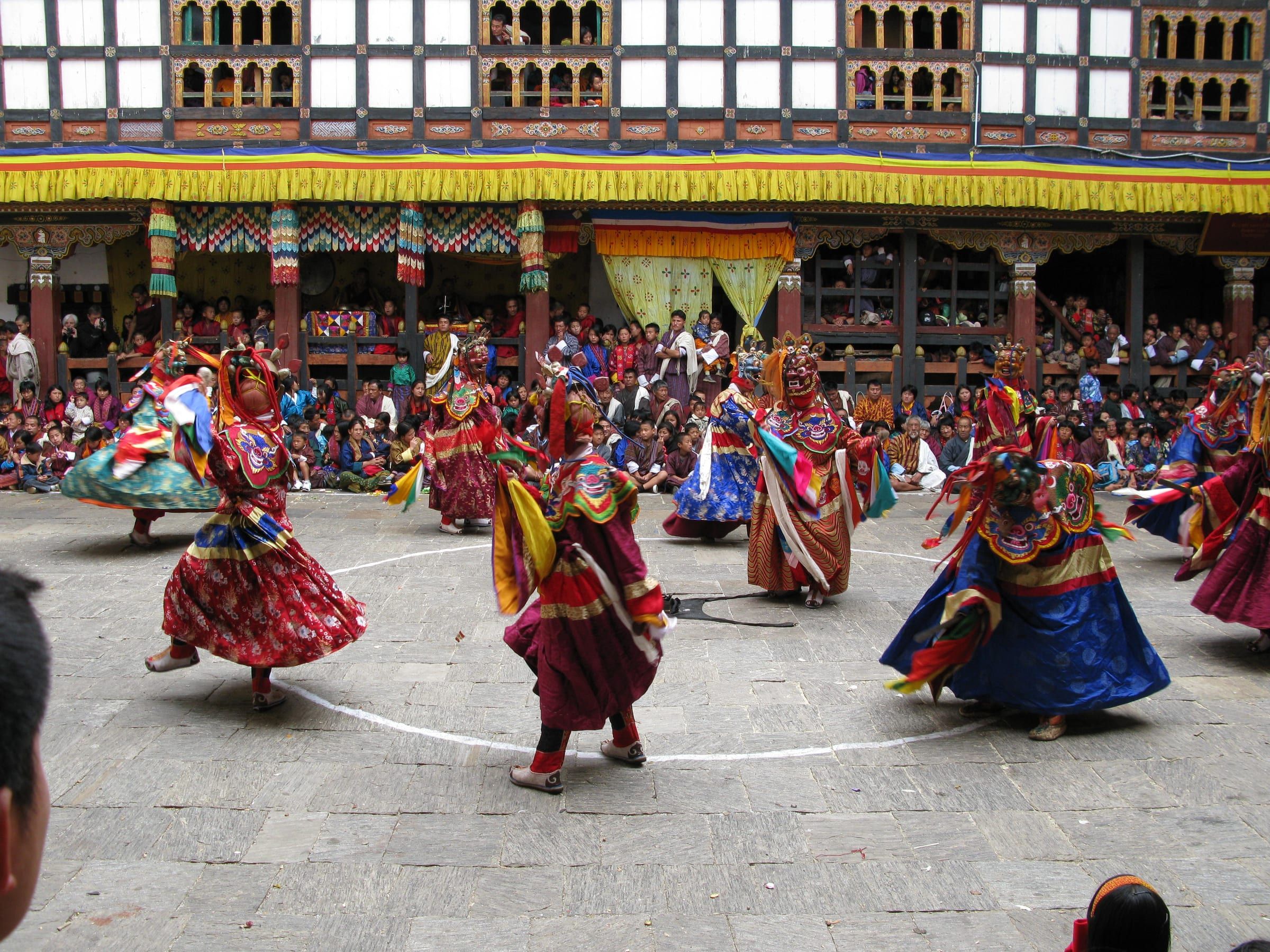
The festival is held in the courtyard of Trashigang Dzong. The name means Fortress of the Auspicious Hill.
The dzong (fortress) stands on a mountain ledge with steep cliffs on three sides, above a river confluence on the Drangme Chhu. The only way in is from the north, along a narrow road blasted through the cliff-side. On the left of the entry gate is a slate carving of Seng Doma, a local protector who is half male and half female.
Inside are six lhakhangs (chapels), and a statue of Zhabdrung Ngawang Namgyal, Bhutan’s state founder, is usually kept here. The dzong is the seat of the Trashigang district administration and of the Trashigang Rabdey (the district monastic body), a Drukpa Kagyu congregation.
Trashigang Dzong is one of 20 dzongs that form a key part of Bhutan’s built heritage. The local community has used and cared for it continuously for almost 400 years, and it is still a centre of traditional arts and crafts and ritual practice.
History
Trashigang Tshechu was instituted more than 300 years ago by Chogyal Minjur Tenpa.
The dzong was built to defend against Tibetan invasions. According to tradition, retreating Tibetan armies called it a Sky Dzong, not one on the ground. It was consecrated and named Trashigang by Dudjom Jigdral Yeshe Dorje, and it has been the political stronghold of eastern Bhutan for over 300 years. It was enlarged in 1936.
Trashigang stood where several trade routes between Tibet and India met, used at different times in summer and winter. British colonial writers of the nineteenth century took it to be the origin of the Bhutan–Assam trade route. The dzong’s administration itself traded across the border with British India. Goods made in the Trashigang valley included stick lac, used to dye the raw silk cloth worn by Monpas and eastern Bhutanese, and straight iron swords three feet long. Tibetan traders frequented the town, and goods moved on south into Assam. The cross-border route was cut when the border closed in 1962.
After the 1962 Sino-Indian War, Indian soldiers returning home through eastern Bhutan had to leave their rifles in the dzong’s armoury and go on unarmed. The rifles are still in the dzong.
In September 2009 a powerful earthquake struck 16 km from the dzong, and its tremors left wide cracks in the structure. The World Monuments Fund, the Bhutan Foundation and the Prince Claus Fund for Culture and Development worked together on emergency repairs here and at Drametse Lhakhang. They built retaining walls against soil erosion, repaired the timber structure and stone walls, and improved drainage. The Bhutanese government paid for local craftsmen to train in earthquake-resistant restoration. Extensive renovation work on the dzong finished in 2019.
Dances and rituals
One of the dzong’s lhakhangs is dedicated to Choegi Gyelpo (Yama), the wrathful aspect of Chenresig. Yama is the god of death and king of law, who weighs good and evil at the end of a life. Lamas perform many dances in Trashigang to appease him.
Being there
Tour groups usually reach Trashigang from Paro and Thimphu, heading east through Bumthang. Trashigang lies at the eastern end of the Thimphu–Trashigang Highway, which is 489.33 km long.
The Trashigang–Samdrup Jongkhar Highway gives a southern route between Trashigang and the Indian border.
Yonphula Domestic Airport is at Kanglung in Trashigang. Flights there have failed to land in dense fog and strong crosswinds.
More hotels and lodgings have been built in Trashigang for the tourists who crowd the small town during the festivals at Trashigang Dzong and Gomphu Kora.
Mongar Dzong is a good half day’s drive from Trashigang Dzong. Gomphu Kora in Trashiyangtse, staged by the monks of Trashigang Dzong, falls months apart from Trashigang Tshechu.