Jambay Lhakhang Drup
- Kind
- Drubchen or dromchoe
- Venue
- Jambay Lhakhang
- District
- Bumthang
- Region
- Central Bhutan
- Tentative
- Tentative
When it happens
It is usually held in autumn, and is reported to fall in October in some years and November in others.
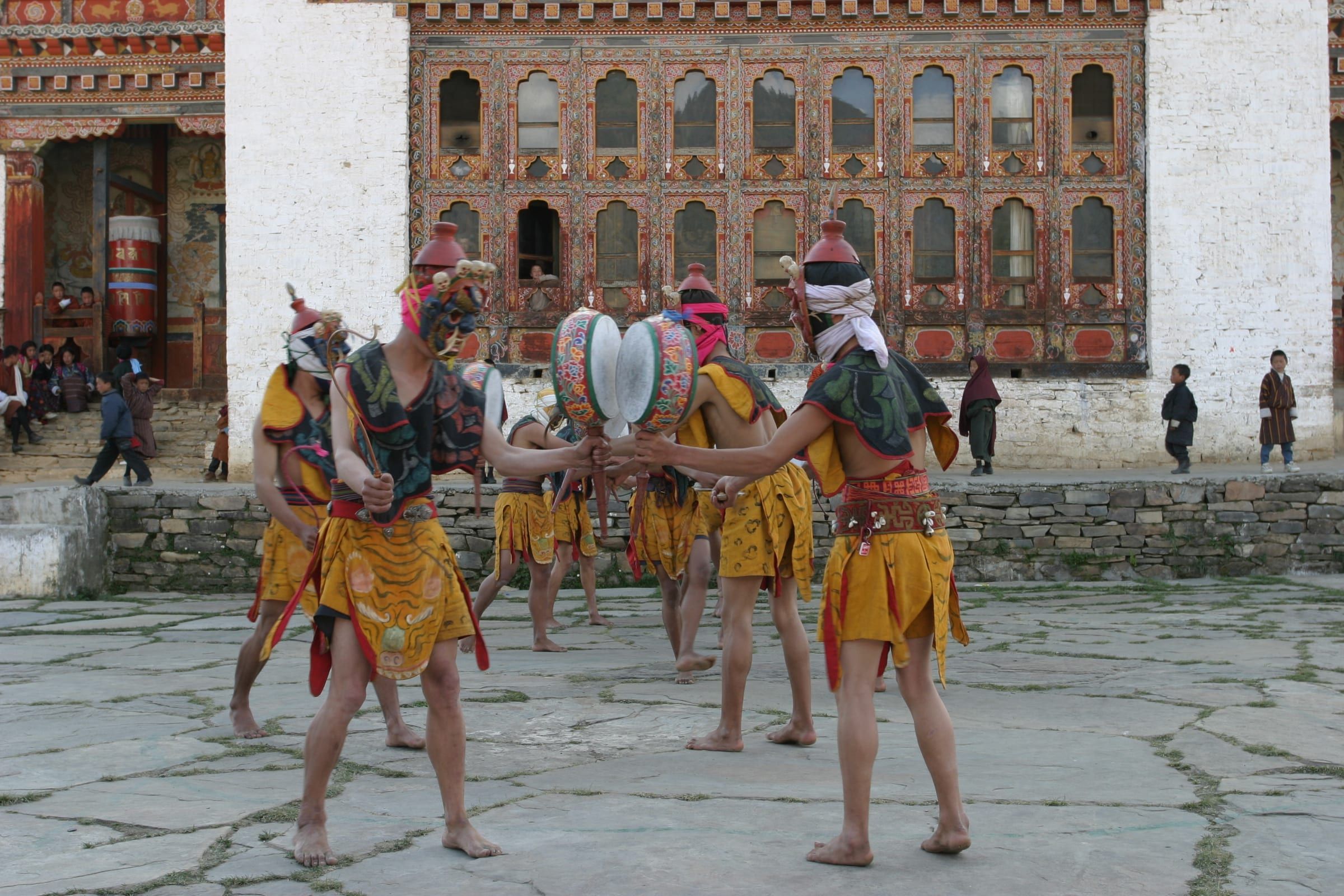
It runs five days, though it has also been reported as a four-day festival. The tercham (naked dance) is danced after midnight on each of the first three nights.
Jambay Lhakhang Singye Cham, also held at Jambay Lhakhang, is a separate festival and not part of this one.
Where it happens
Jambay Lhakhang stands in the Choekhor valley of Bumthang, on a plateau by the Bumthang Chhu. The festival’s mask dances are performed in the closed courtyard in front of the temple’s main sanctuary. The mewang (fire ritual) is reported to take place in a nearby agricultural field, and the tercham is danced in an outer courtyard on the temple’s western side.
Four further sanctuaries, reconstructed in the middle of the 19th century, enclose the courtyard in front of the main sanctuary. The Dukhor (Kalacakra) sanctuary on its north side was built at the end of the 19th century by Jigme Namgyal and his son Ugyen Wangchuck. The Guru Lhakhang on its south side was founded in the mid-19th century by Tsondru Gyeltsen. The Sangye Rabduen Lhakhang, above the main eastern entrance, was founded by the second King, Jigme Wangchuck.
The main temple has two floors and a main wall of stone. It is a registered heritage building, owned by the government and still used as a temple.
History
Jambay Lhakhang is among the oldest temples in Bhutan. It was founded by King Songtsen Gampo in the 7th century.
According to tradition, it was the first lhakhang (temple) built in Bhutan. It is said to be one of 108 temples raised in a single day across Tibet, Bhutan and the borderlands to subdue a demoness who was obstructing the spread of Buddhism, and tradition gives the year as 659 CE. Jambay Lhakhang is said to stand on the demoness’s left knee, and Kyichu Lhakhang in Paro on her left foot, pinning down the frontiers.
Guru Rinpoche is said to have visited the temple and preached to King Sindhu Raja and his court from its roof. The king is said to have restored the temple after Guru Rinpoche returned his life force. The complex was partially restored in 1905 by Chime Dorje, brother-in-law of Ugyen Wangchuck.
The festival is said to have been instituted around the 14th century by Dorje Lingpa, after he renovated the temple. By this account it was the temple’s consecration ceremony, prophesied by Guru Rinpoche. It is described as a festival of mask dances and rituals in the Dorling tradition of Buddhism.
The descendants of Chakhar Lam are reported to carry the tradition on today, with the villages around the temple. The villages that conduct it are reported to include Chawang, Norgang, Nashphel and Jambay Lhakhang.
Rituals
The mewang and the tercham are usually described as the festival’s main draws.
Before the mewang, several mask dances are reported to be performed within the temple grounds. They are accompanied by a Gegtrey (purification) ritual, whose purpose is described as purifying the site and cleansing spectators of their misdeeds.
At the mewang, accounts describe how a gate-like structure covered with leaves is set alight while monks conduct the ritual and spectators run through the burning gate. Running through it is said to relieve them of their sins and evil. The purpose of rituals such as the mewang is described as bringing peace and harmony to the country, and the mewang’s blessing is held to clear the obstacles that hinder a person’s wellbeing.
The tercham is danced by laymen from the villages that conduct the festival, their faces wrapped in white cloth. One tradition holds that Guru Rinpoche first performed it while Nabji Lhakhang in Trongsa was being built. The demons and spirits are said to have been so absorbed in the dance that he could complete the building. For this reason, tradition asks spectators to pray sincerely and to regard the dancers as Guru Rinpoche himself.
The dancers’ own relatives are reported to watch. The discomfort and embarrassment this brings is held to relieve ill fortune.
Being there
Cameras and mobile phones are described as not allowed for filming the tercham. Because it is usually performed at night, in the early hours, plan for a late night and the cold.